RSGB FT8 Eclipse Contest 2026: GM5G Station Report
Results Released: GM5G came 3rd in the open section
This report summarises the operations of station GM1TGY using the contest callsign GM5G during the RSGB FT8 Eclipse contest on 12 August 2026. The station was operated by MM9SQL and GM1TGY from Aberlour in Moray.
Station Configuration
- Contest Callsign: GM5G
- Operators: MM9SQL and GM1TGY
- Location: Aberlour, Moray (Locator IO87IK)
- Antenna: 40m dipole at 10m above ground
- Power: 600w
- Mode: FT8
Contest Operations and Log Summary
The contest took place during the afternoon and early evening, operating entirely on the 40m band. The wsjtx_log.adi file confirms a total of 87 QSOs were logged over the three-hour operating window from 16:30 to 19:30 UTC. The combination of 600w and the 40m dipole provided consistent performance throughout the session.
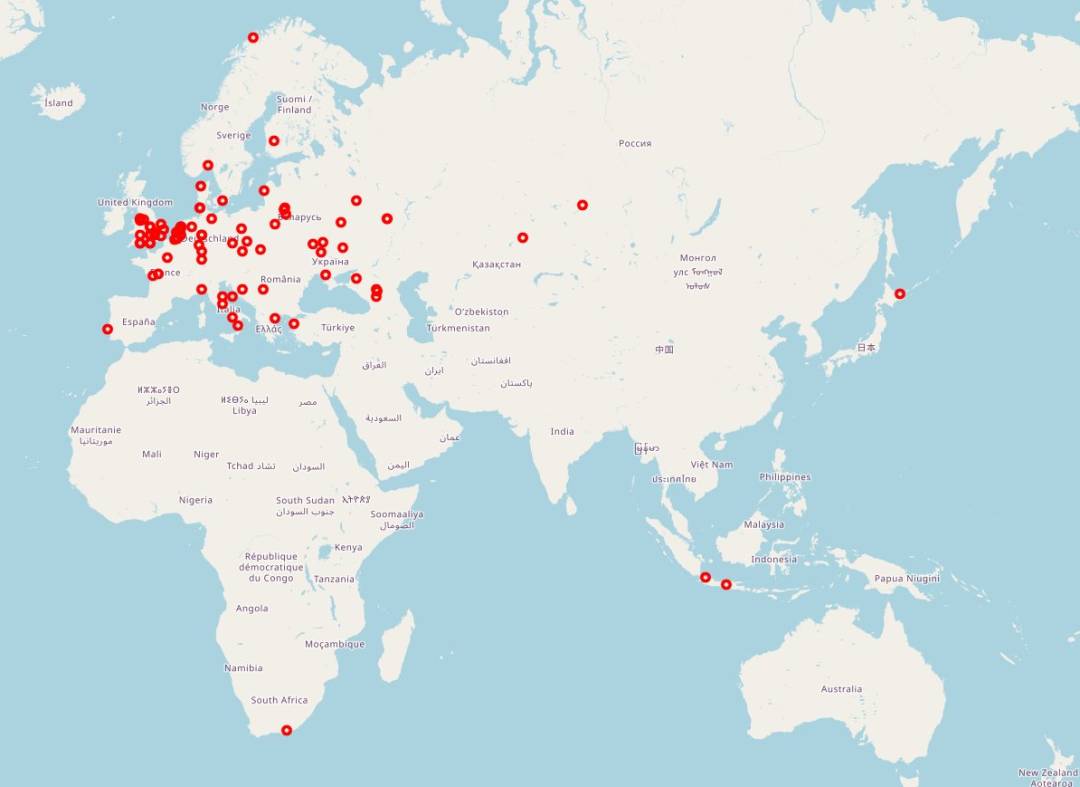
The spatial distribution of the contacts is plotted. The map indicates a high density of regional contacts across Europe. Consistent propagation was observed into Germany, the Netherlands, Italy, Poland, and Ukraine, alongside reliable local coverage within the UK.
Solar Eclipse Propagation Analysis
The timing of this short-duration contest was explicitly set to investigate propagation effects caused by the partial solar eclipse on 12 August 2026.
As the eclipse progressed, the reduction in solar radiation decreased F2 and E-layer illumination. Concurrently, the lack of solar energy resulted in a reduction of D-region absorption. The D-region is responsible for absorbing lower-frequency signals during daylight hours, so this sudden drop in absorption directly impacts propagation on bands like 80m and 40m. Essentially, the eclipse temporarily removes the typical daytime signal attenuation, allowing 7 MHz signals to travel much further than they normally would during the afternoon.
This physical change is evident when analysing the wsjtx_log.adi file. The reduced daytime absorption opened long-distance and intercontinental propagation earlier in the day than normally expected for mid-August. Notable DX contacts achieved during the eclipse window include:
- Asia: JA8EPO in Japan at 18:09 UTC and UN6GO in Kazakhstan at 17:14 UTC.
- South East Asia: 8H81YK at 16:55 UTC and YC2KTO in Indonesia at 17:23 UTC.
- Africa: ZS2PA in South Africa at 18:35 UTC.
The operations at GM5G successfully captured the propagation enhancements induced by the eclipse. The station hardware performed exactly as required, and the resulting log provides clear evidence of the ionospheric changes caused by the celestial event.